
How to Capture Unique Professional Methodology
Table of Contents
- What Capturing a Unique Professional Methodology Actually Means
- Knowledge Capture Interview Questions That Elicit What You Actually Do
- Capturing Tacit Knowledge: Documenting Judgment You Never Wrote Down
- Creating a Signature Framework From Your Accumulated Expertise
- Professional Methodology Examples: From Advisor Philosophy to Keynote System
- Validating and Maintaining Your Documented Professional Methodology
- Conclusion: From Private Judgment to Lasting Authority Asset
- Frequently Asked Questions
Last Updated: October 16, 2026
What Capturing a Unique Professional Methodology Actually Means
Capturing a unique professional methodology means writing down how you actually make decisions, not just what you recommend.
At SpearPoint Ink, we work with advisors, speakers, and coaches whose value lives in how they think, yet little of it exists in written form.
The cost shows up predictably.
The U.S. Bureau of Labor Statistics occupational outlook data shows steady growth in consulting and advisory roles, which means more competition for the same clients.
The Uniqueness Test: Separating Signature Method From Standard Practice
Most professionals believe their approach is unique; fewer can prove it. Before documenting a methodology, separate genuine differentiation from industry-standard practice dressed up in personal language.
We use a four-part test. A methodology is genuinely unique only when it clears all four:
- The Substitution Test. Swap your name for a competitor's. If the description still reads true, it is not unique. "I build diversified portfolios for retirees" fails. "I rebalance only when a client's withdrawal rate drifts more than a set band" may pass, because the trigger is specific to how you work.
- The Counterfactual Test. Ask what you would refuse to do that peers routinely do. Refusals reveal a decision rule. If you cannot name a common practice you reject, your method is probably a preference, not a system.
- The Origin Test. Trace the rule to a specific case, failure, or mentor. Rules with an origin story tend to be load-bearing. Rules that appeared because "it seemed reasonable" tend to be borrowed from the field at large.
- The Prediction Test. State what your method predicts that a generic approach would miss. If you can name a client outcome you would have caught earlier than a peer, you have a testable claim.
A useful exercise: write your method in one paragraph and hand it to a colleague who does not know your work. Ask them to name three things only you would say. If they cannot, the paragraph describes the profession, not you.
The Three Layers of a Capturable Methodology
Uniqueness lives at different depths, each needing a different capture technique.
- Layer 1: Stated philosophy. What you tell clients you believe. Easy to write, easy to copy, low defensibility. Capture it in a five-to-seven-sentence manifesto.
- Layer 2: Decision rules. The triggers and thresholds you apply mid-case. This is where most of your value sits. Capture it through case-by-case interviews, not reflection.
- Layer 3: Judgment calls. The moments you override your own rules because something feels off. Hardest to capture and copy, and the reason clients pay a premium. Capture it by recording yourself narrating a live decision after the fact.
Most experts document Layer 1 and stop, producing a philosophy page rather than a methodology. The asset becomes defensible only when Layers 2 and 3 are specific enough for another trained professional to follow.
What Counts as Captured
A methodology is captured when a stranger can read it, a trained peer can follow it, and you can point to a case where it produced a different outcome than the default approach. Until then, you have notes.
Knowledge Capture Interview Questions That Elicit What You Actually Do
The fastest way to capture a unique professional methodology is a structured interview with someone asking the right questions. You cannot do this alone, because you skip what feels obvious.
Here are the knowledge capture interview questions we use most often:
- Walk me through the last client decision you made. What did you notice first?
- What do you check before you commit to a recommendation?
- When have you been wrong? What signal did you miss?
- What do less experienced people in your field get wrong here?
- What would you refuse to do, even if a client asked?
- How do you know when a plan is working, before the results arrive?
These questions ask for process, not opinion. Opinions are easy to produce and hard to use; process is what a client actually buys.
Record the sessions. Transcribe them. The transcript becomes raw material you will shape later.
Capturing Tacit Knowledge: Documenting Judgment You Never Wrote Down
Tacit knowledge is the judgment you apply without being able to state the rule, the reason a seasoned advisor pauses before saying yes (Tacit knowledge).
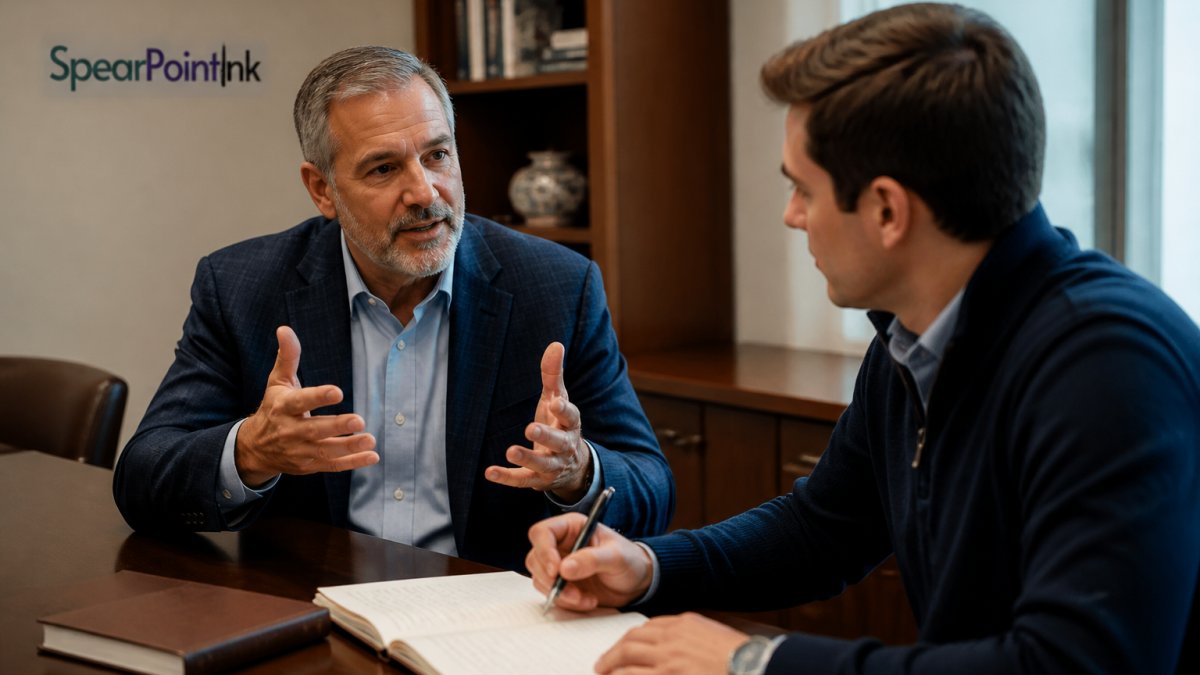
To get it on paper, work backward from decisions. Pick five calls from the past year and answer three questions for each:
- What did I see that others might have missed?
- What rule of thumb was I applying?
- What would have changed my mind?
Patterns emerge fast: most experts rely on four or five core signals, which become the backbone of your documented professional methodology.
A common mistake is writing these as principles. Write them as triggers instead. "When a client's timeline is shorter than the payback period, I slow down" is usable.
Creating a Signature Framework From Your Accumulated Expertise
A signature framework is a named, ordered set of steps showing how you work, the public face of your professional methodology.
Build it in four moves:
- Group your decision triggers into stages
- Name each stage in plain language
- Write one sentence explaining what happens at each stage
- Add the question you ask before moving on
The result should fit on one page. If it needs three pages, you have not grouped enough.
This is the same work we do at SpearPoint Ink when we help experts turn years of judgment into a book or client education system.
| Stage | What Happens | Question Before Moving On |
|---|---|---|
| Intake | Gather facts and constraints | Do I understand the real goal? |
| Diagnosis | Identify the core problem | What am I missing? |
| Design | Build the plan | Does this fit their timeline? |
| Review | Test against past cases | Would I bet on this? |
Professional Methodology Examples: From Advisor Philosophy to Keynote System
Two examples show how different the output can look.
An advisor's philosophy might read as short rules about when to hold and when to move, quiet, specific, tied to client situations.
A speaker's system might read as a named talk structure with three movements and a closing challenge, built for a stage and needing rhythm and repetition.
Both are professional methodology examples: each records how the person thinks, in a format their audience can absorb.
Christopher Zeches turned years of expertise into what he calls The Binder On The Shelf.
Validating and Maintaining Your Documented Professional Methodology
A documented professional methodology is useful only if it still matches how you work and someone else can reproduce the result. Validation turns a personal write-up into an asset you can hand to a client, licensee, or new hire.
The Reproducibility Test
Pick a colleague who has never seen your method. Give them the written version and one real case stripped of your conclusion, ask them to work it using only the document, then compare their recommendation to yours.
Three outcomes are possible:
- Convergent. They reach the same decision and can explain why. The method is reproducible.
- Divergent but defensible. They reach a different decision using your rules. The rules are ambiguous somewhere. Find the branch point and add the missing trigger.
- Divergent and lost. They cannot apply the rules at all. The document is describing outcomes, not process. Rewrite the affected stage as a sequence of questions.
Run this test with at least two people before treating the methodology as stable. One tester can be lucky; two reveal structure.
Documenting Limitations and Scope
Every methodology has a boundary. Writing it down protects you and your clients.
A limitations section should state, in plain language:
- The client types the method was built for and the ones it was not
- The conditions under which the method produces weaker results
- The evidence base, whether that is years of practice, a set of case studies, or a formal study
This is not a legal disclaimer but a credibility signal. Advisors who name their limits are trusted more, because boundaries prove the method was tested against real cases rather than assembled from theory.
Consent, Attribution, and Confidentiality
If your methodology was developed through client work, the examples carry obligations.
- Get written permission before using a client case, even anonymized. A short email confirming consent is enough for most engagements, but keep it on file.
- Strip identifying details that could re-identify a client even without a name: employer, industry plus city, unusual circumstances, or a distinctive combination of facts.
- Attribute borrowed frameworks. If a stage in your method came from a mentor, a certification program, or a published source, credit it. Attribution does not weaken your methodology. It shows you know where your thinking came from.
For most independent practitioners, a simple internal policy works: no client case enters the methodology document without a signed release, and no borrowed framework enters without a citation.
Version Control and the Change Log
Treat the methodology document like software. Every revision gets a version number, a date, and a one-line reason for the change.
A workable structure:
| Version | Date | Change | Trigger |
|---|---|---|---|
| 1.0 | Q1 | Initial capture | First full draft |
| 1.1 | Q2 | Added intake trigger for short timelines | Two cases where the rule would have changed the recommendation |
| 2.0 | Q4 | Restructured diagnosis stage | Reproducibility test failed with two testers |
Review on a fixed cadence, quarterly for active practices, annually for slower ones, and log changes as they happen. A change log becomes evidence of professional rigor when you present the method to a prospective client or meeting planner, showing it is maintained rather than frozen.
Storage, Access, and Sharing
Where the document lives determines how useful it stays.
- Single source of truth. One canonical file, versioned, with older versions archived rather than overwritten. Cloud storage with version history handles this without extra tooling.
- Access tiers. A public-facing summary for prospects, a full version for clients and licensees, and an internal version with case notes and limitations.
- Update ownership. Name one person responsible for merging changes. Shared editing without an owner produces drift.
When to Rebuild Rather Than Revise
Minor drift calls for a revision. A shift in the underlying model calls for a rebuild.
Rebuild when your client base changes materially, when a core decision rule has been overridden more than twice in a year, or when the reproducibility test fails at the stage level rather than the trigger level. A rebuild is not a failure. It is the method catching up to the practitioner.
Conclusion: From Private Judgment to Lasting Authority Asset
The hard part of capturing a unique professional methodology is not the writing.
Most experts never make that leap; their best thinking stays private and leaves when they do.
SpearPoint Ink helps advisors, speakers, and coaches turn that private judgment into Authority Assets.
Book a call with SpearPoint Ink and turn your methodology into an asset that outlasts the meeting.
Frequently Asked Questions
How do I know if my professional methodology is actually unique enough to document?
Your methodology is unique if it produces decisions, recommendations, or outcomes that differ from what a competent peer would produce given the same information. Look for patterns in how you handle edge cases, what you prioritize when trade-offs appear, and which questions you always ask before acting. If clients or colleagues regularly say 'I would never have thought of it that way,' that reaction signals a distinct approach worth capturing. Documenting it starts with the knowledge capture interview questions that surface your decision logic, not just your stated process.
What questions help uncover tacit professional knowledge during a knowledge capture interview?
Start with decision-reconstruction questions: 'Walk me through the last time you deviated from your usual approach and why.' Then probe for heuristics: 'What signal tells you a client is ready versus not ready?' and 'What do you check first, and what do you ignore?' Ask about failure patterns: 'Tell me about a time your usual method did not work, and what you changed.' These questions pull out the judgment calls that never appear in a standard process document, which is exactly the tacit knowledge that makes your methodology distinct.
How do I protect my proprietary methodology while still sharing it publicly?
Separate the framework from the implementation. Publish the named stages, the principles behind each stage, and the outcomes clients can expect. Keep the specific diagnostic tools, scoring models, and internal decision trees confidential. You can also layer your disclosure: share the 'what' and 'why' publicly, and reserve the 'how' for paying clients. If you work with a ghostwriter or book coach, use a confidentiality agreement that defines what counts as proprietary and who retains ownership of the underlying methodology.
How often should I update my documented professional methodology?
Review it annually and after any significant shift in your market, client base, or decision framework. A practical trigger is when you notice yourself consistently giving advice that contradicts what is written. At that point, the document is lagging behind your thinking. Build a short revision log at the end of the document so you can track how the methodology evolved. This keeps the asset credible and prevents the outdated-feeling problem that worries many experts mid-project.


