
Is a Business Book Ghostwriter for Entrepreneurs Worth It?
Last Updated: October 26, 2026
Quick Summary
A business book ghostwriter for entrepreneurs is a professional writer who turns a founder's spoken expertise into a finished manuscript under the founder's name, creating an authority asset rather than a vanity project. Full ghostwriting suits founders with no writing time, while book coaching suits those who want to draft the book themselves.
- Full ghostwriting means the writer drafts the manuscript from interviews and source material.
- Interview hours, methodology complexity, source material, revision rounds and timeline drive the quote.
- Most contracts include two to three revision rounds, with additional rounds billed hourly or per round.
- Score every candidate on the same eight criteria, weighting voice, strategy and interview skill highly.
- The client should hold the copyright, and that assignment should be explicit in the contract.
Table of Contents
- What a Business Book Ghostwriter for Entrepreneurs Actually Delivers
- Comparing Service Models: Full Ghostwriting, Book Coaching, and Marketplaces
- What a Business Book Ghostwriter Costs and What Drives the Quote
- The Business Book Ghostwriting Process From First Call to Manuscript
- How a Ghostwriter Captures My Voice Instead of Flattening It
- How to Vet a Business Book Ghostwriter for Hire
- Ownership, Confidentiality, and Attribution Before You Sign
- Measuring Return Beyond Book Sales
- Frequently Asked Questions
What a Business Book Ghostwriter for Entrepreneurs Actually Delivers
A business book ghostwriter for entrepreneurs is a professional writer who turns a founder's spoken expertise into a finished manuscript under the founder's name.
At SpearPoint Ink, we build these assets for advisors, speakers, and founders. The work starts with recovering what gets lost in normal business communication.
That distinction matters more than most buyers realize. A book that restates your marketing copy is a brochure with a spine.
The Difference Between a Book and an Authority Asset
An authority asset is a book designed to work after the meeting ends. It demonstrates your judgment before a prospect hires you, and it keeps demonstrating it while you sleep.
Three practical tests separate the two categories:
- Does the book contain reasoning a competitor could not copy without your experience?
- Can a reader finish it and describe your method to someone else?
- Does it hold up when your thinking evolves, or does it date within a year?
A book that passes all three becomes a client education system, not a shelf ornament.
Comparing Service Models: Full Ghostwriting, Book Coaching, and Marketplaces
Three models dominate the market, and they differ in who carries the burden of production. Full ghostwriting means the writer drafts the manuscript from interviews and source material. Book coaching means you write and a coach guides structure and accountability. Marketplaces are directories where you compare individual writers and hire one directly.
The distinction is not who has the better ideas. If you want a clear breakdown of that trade-off, our comparison of ghostwriter vs. book coach explains which model fits which working style.
Marketplaces such as Reedsy's business ghostwriter directory let you scan profiles and experience levels. Individual practitioners like Lisa Tener and Derek Lewis present business-book services directly.
| Model | Who Writes | Your Time Cost | Best For | Main Risk |
|---|---|---|---|---|
| Full ghostwriting | Professional writer | Interviews and reviews | Founders with no writing time | Weak voice matching |
| Book coaching | You, with guidance | Heavy writing hours | Writers who want control | Stalled drafts |
| Marketplace hire | Individual freelancer | Varies by contract | Buyers who want to compare | Inconsistent process |
| Agency | Team of writers | Interviews and approvals | Complex or fast projects | Less direct access |
Best for: entrepreneurs who want the thinking captured without becoming writers. Skip if: you genuinely want to draft the book yourself and only need structure.
What a Business Book Ghostwriter Costs and What Drives the Quote
Pricing for business book ghostwriting engagements varies significantly, and understanding the factors that influence a quote is crucial for fair comparison. Two books of the same length can differ by tens of thousands of dollars based on the variables below.
What moves the number most:
- Interview hours. Every recorded hour must be transcribed, coded, outlined, and drafted from. A founder-led book requires a significant number of recorded interviews; a framework-heavy book can require even more.
- Complexity of the methodology. A book built around a proprietary framework needs structural work to test the logic, not just transcribe it.
- Source material. Existing keynotes, internal documents, and prior writing reduce discovery hours and lower the quote.
Fee Structures You Will See
| Structure | How It Works | Watch For |
|---|---|---|
| Flat project fee | One price for the full manuscript | Confirm what is excluded (indexing, cover copy, developmental edit) |
| Milestone payments | 30-50% deposit, balance on outline, draft, and final | Tie each payment to a deliverable, not a date |
| Hourly | Billed per interview or writing hour | Hard to budget; cap total hours in writing |
| Royalty share | Lower upfront fee in exchange for a percentage | Rare for business books; scrutinize term and buyout |
Contract Terms That Change the Real Cost
- Revision limits. A contract that includes "revisions until satisfied" is worth more than one capped at two rounds, but confirm the definition of a round.
- Kill fee. If you cancel mid-project, what do you owe? A common structure is payment for work completed plus a percentage of the remaining balance.
- Rights and royalties. Confirm the writer assigns copyright to you and does not retain a royalty unless you agreed to one.
If you want to see how cost is structured before you request a quote, our breakdown of business ghostwriting pricing covers what drives the figure and where engagements begin.
The Business Book Ghostwriting Process From First Call to Manuscript
The process runs in defined stages, and each stage produces something you can review. Ours moves from a discovery call through concept development, recorded interviews, outlining, chapter drafting, and revision.
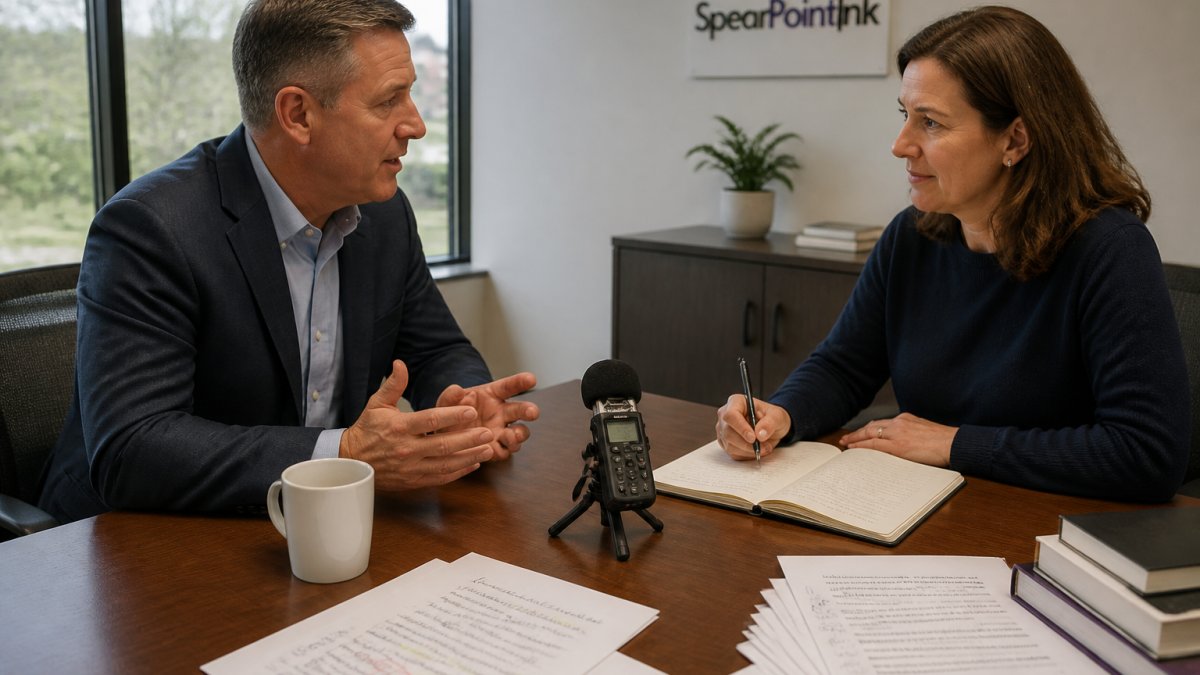
Here is the sequence we follow:
- Discovery call. We map your expertise, audience, and commercial goal for the book.
- Concept development. We position the book so it says something only you can say.
- Recorded interviews. We capture your methods, stories, and reasoning in your own words.
- Outline and chapter development. We build the structure, then draft chapter by chapter.
- Revision. You review drafts and we refine until the manuscript sounds like you.
- Final manuscript. You receive a complete, edited book ready for your publishing path.
Most clients want to know how much of their own calendar this consumes.
Watch out: projects stall when the client treats interviews as optional. The manuscript can only be as good as the source material you provide.
How a Ghostwriter Captures My Voice Instead of Flattening It
Voice matching comes from recorded conversation, not from style questionnaires.
The failure mode is real.
Our approach treats your spoken explanations as the source material. We record interviews, study how you phrase things, and draft from transcripts.
If you are coming from a coaching relationship, expect a different rhythm. Coaching helps you write. Ghostwriting means someone else writes, and you approve.
How to Vet a Business Book Ghostwriter for Hire
Vetting comes down to evidence of process, not charm on a call. Use the same scorecard for every candidate and rate each criterion 1-5, then compare totals side by side. The criteria below are weighted for founder-led business books, where voice, strategic thinking, and interview skill matter more than literary pedigree.
The Entrepreneur's Ghostwriter Scorecard
| Criterion | What to Look For | Weight |
|---|---|---|
| Industry familiarity | Has written in or adjacent to your category; can name comparable books | High |
| Interview style | Asks follow-up questions that surface reasoning, not just stories; comfortable challenging your logic | High |
| Strategic thinking | Can articulate the book's positioning and audience before you explain it | High |
| Voice matching | Shares sample chapters and explains how they captured the client's cadence | High |
| Founder-led book experience | Has worked with entrepreneurs, not only executives or academics | Medium |
| Process specificity | Describes stages, deliverables, and revision rounds in concrete terms | Medium |
| References | Provides two clients you can call, ideally in your category | Medium |
| Contract clarity | Ownership, confidentiality, and revision limits stated in writing | High |
Questions That Reveal Process
- Can you walk me through your last three projects stage by stage, including where they stalled and how you recovered?
- How do you handle a founder who gives long, tangential answers? (Listen for a specific technique, not a platitude.)
- Will you show me a sample chapter and tell me what the client contributed versus what you wrote?
Christopher Zeches turned his expertise into The Binder On The Shelf through our process, and the outcome is the kind of concrete result you should ask any writer to describe.
Red Flags in the Sales Conversation
- A quote with no scope document attached.
- Reluctance to share sample chapters or client references.
- A promise to "capture your voice" without describing how.
A common mistake is choosing the cheapest quote without checking what it includes. A low figure often excludes interview hours, developmental editing, or revision rounds, and the true cost emerges mid-project.
When you are ready to talk through fit, you can book a call with our team directly.
Ownership, Confidentiality, and Attribution Before You Sign
Ownership should be explicit in the contract, and the client should hold the copyright. Anything less deserves scrutiny before you sign.
Three terms to confirm in writing:
- Copyright assignment. The finished manuscript and the underlying material should transfer to you.
- Confidentiality. Interviews often contain client stories and proprietary methods. The agreement should protect both.
- Attribution. Decide upfront whether the writer is named anywhere, or whether the book is entirely yours.
The U.S. Copyright Office guidance on works made for hire explains how authorship and ownership are treated when someone writes on your behalf. Read it before signing anything.
A proper proposal covers scope, interviews, revisions, timeline, price, ownership, and contract terms.
Measuring Return Beyond Book Sales
Book sales are the least useful metric for a business book. The return shows up in conversations, not in royalty statements.
Measure these instead:
- Qualified inbound inquiries that mention the book.
- Speaking engagements where the book opened the door or closed the deal.
- Client education use, such as sending chapters to prospects during onboarding.
A founder who hands a prospect a book has demonstrated how they think before the first billable hour. That is the asset working.
The real risk is not hiring the wrong writer. It is spending years with your best thinking trapped in meetings, decks, and conversations that end.
Frequently Asked Questions
How much does it cost to hire a business book ghostwriter?
There is no single rate. A business book ghostwriter cost depends on manuscript length, how much interview time you need, the complexity of your material, and whether the scope includes outlining, editing, or publishing support. Pricing depends on quantity, dates, and delivery. Ask for a written scope that names deliverables, revision rounds, and timeline, then request a quote specific to your project instead of comparing headline numbers.
How do you make sure a ghostwriter captures my voice?
A ghostwriter captures my voice by working from source material rather than a questionnaire. That means recorded interviews, existing talks, client emails, internal memos, and notes you already keep. The writer studies how you explain a problem, which examples you reach for, and where you compress your thinking. Expect sample chapters early so you can correct tone before the full draft. If a provider cannot describe a voice-matching step in specific terms, that is a warning sign.
How long does it take to ghostwrite a business book?
Timelines vary with scope and how quickly you can sit for interviews. A typical business book ghostwriting process runs several months, with the largest share of time going to interviews and chapter development rather than drafting. Your own workload matters: expect to spend a few hours per chapter on recorded conversations and review. Ask any provider for a milestone schedule with dates for the outline, sample chapter, full draft, and revisions, and confirm what happens if your availability slips.
Can ChatGPT replace a business book ghostwriter?
AI tools can draft sentences, but they cannot recover the judgment behind your frameworks or tell which client story proves the point. The risk is a manuscript that reads generically and repeats what is already published. Use AI for research organization or first-pass summaries if you like, then have a professional writer shape the argument and match your voice. Ask any business book ghostwriter for hire how they use AI and who reviews the output before it reaches you.
What should a contract cover before I hire a ghostwriter?
Confirm four things in writing. First, ownership: the copyright and all rights should transfer to you on final payment. Second, confidentiality: your client stories and proprietary methods should be protected, and the writer should agree not to reuse your material. Third, attribution: decide whether the writer is named, credited as editor, or invisible. Fourth, revisions: state how many rounds are included and what counts as a new request. Get the payment schedule tied to milestones rather than dates alone.


