
Are Ghostwriting Services for Consultants Worth It?
Last Updated: November 10, 2026
Quick Summary
Ghostwriting services for consultants are worth it when the provider can extract what you already know and preserve how you think, turning your judgment into a book, keynote, or content system that keeps working after the meeting ends. Choose deliberately by comparing providers on fit, process, and cost rather than by referral alone.
- SpearPoint Ink treats a book as an authority asset and is best for voice matching.
- K&A Writing suits consultants chasing a commercially positioned nonfiction book.
- Bestseller Publishing handles recurring LinkedIn content on a monthly retainer.
- Recurring LinkedIn and thought-leadership ghostwriting generally runs $2,000 to $8,000 per month.
- Score two or three finalists on a weighted scorecard instead of using an unscored checklist.
Table of Contents
- Quick Comparison: Ghostwriting Services for Consultants
- SpearPoint Ink: Best for Authority Assets and Voice Matching
- K&A Writing: Best for Bestseller-Level Book Development
- Bestseller Publishing: Best for Recurring LinkedIn Content
- Ghostwriters Planet: Best for Brand and Business Content Mix
- What Does a Ghostwriter Cost for a Business Book?
- How to Choose a Ghostwriting Company as a Consultant
- LinkedIn Ghostwriting for Consultants: A Different Scope
- Frequently Asked Questions
Quick Comparison: Ghostwriting Services for Consultants
Ghostwriting services for consultants turn accumulated judgment into a book, keynote, or content system that keeps working after the meeting ends. This guide from SpearPoint Ink compares four providers on fit, process, and cost so you can choose deliberately rather than by referral alone. For a practical side-by-side of major ghostwriting providers, see Scribe Media vs Gotham Ghostwriters.
A consultant's problem is rarely a shortage of ideas. It is that the ideas live in conversation, not on paper. The provider you pick should be the one that can extract what you already know and preserve how you think.
| Provider | Best For | Pricing Model | Watch Out For |
|---|---|---|---|
| SpearPoint Ink | Authority assets and voice matching | Project fee, quoted per engagement | Best suited to leaders with deep expertise already formed |
| K&A Writing | Bestseller-level book development | Custom engagement | Book-only focus; less support for content systems |
| Bestseller Publishing | Recurring LinkedIn content | Monthly retainer | Category range runs $2,000-$8,000/month |
| Ghostwriters Planet | Brand and business content mix | Not published | Verify deliverables before signing |

The man is American. The woman is American.
SpearPoint Ink: Best for Authority Assets and Voice Matching
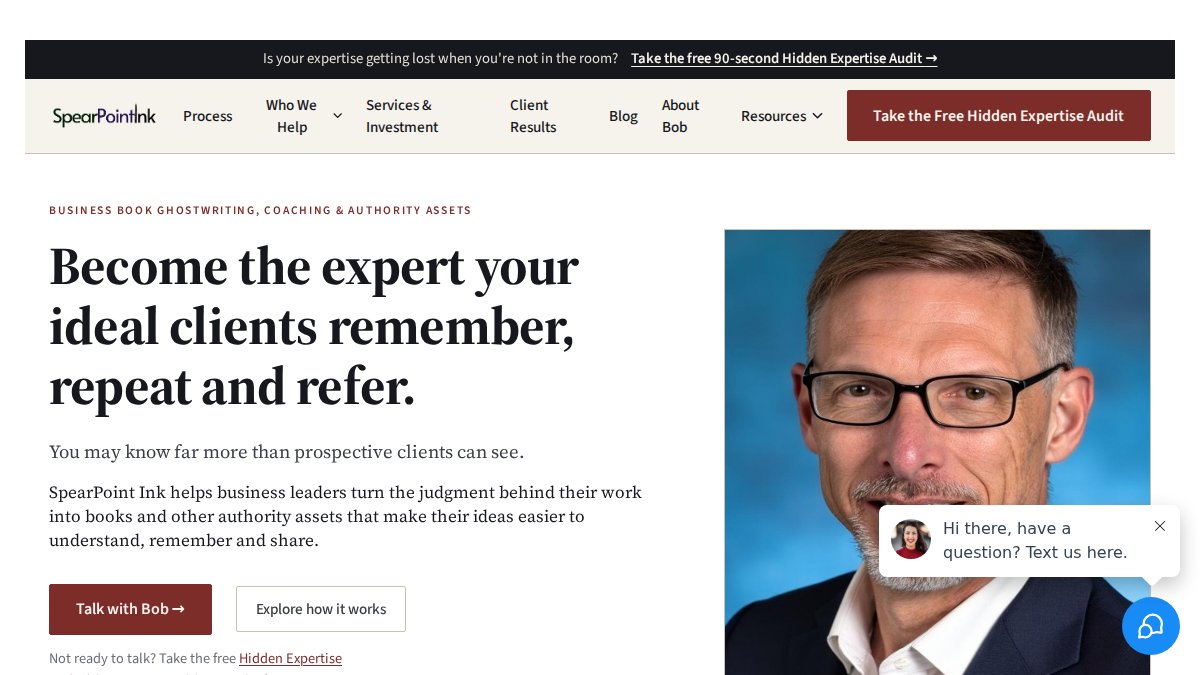
SpearPoint Ink treats a book as an authority asset, not a marketing deliverable. The firm works with advisors, speakers, and coaches whose expertise gets compressed in ordinary marketing until the depth disappears.
That compression is what we call the Explanation Trap. Repeat a framework enough times in pitches and it flattens into a slide. A ghostwriting engagement should recover the source material behind the slide, which is where your actual differentiation lives.
Best for: financial advisors, speakers, and founders who need a book, keynote, or client education system that sounds like them.
K&A Writing: Best for Bestseller-Level Book Development
Best for: consultants chasing a commercially positioned nonfiction book. Skip if: you need ongoing content beyond the manuscript.
Bestseller Publishing: Best for Recurring LinkedIn Content
Budget accordingly. Market ranges for recurring LinkedIn and thought-leadership ghostwriting generally sit between $2,000 and $8,000 per month, according to Bestseller Publishing's entrepreneur comparison. That figure is a category range, not a quote.
Best for: consultants who want consistent social media content and personal brand visibility. Skip if: your priority is a single long-form asset.
Ghostwriters Planet: Best for Brand and Business Content Mix
Best for: consultants who need several content formats from one team.
What Does a Ghostwriter Cost for a Business Book?
Business book ghostwriting is priced by project, and the range is wide. Reedsy's guide to ghostwriter costs reports per-word rates of $0.10 to $3, hourly rates of $35 to $200 or more, and project fees from $1,000 to $100,000.
For a professionally written business book specifically, Authors Unite's cost breakdown lists $30,000 to $60,000 for a mid-range professional ghostwriter, covering interviews, revisions, and style tuning. Amy Suto's ghostwriting cost analysis puts professionally ghostwritten books at $25,000 to $75,000.
Cheaper tiers exist. WriterCosmos's comparison of ghostwriting services separates freelancer rates of $3,000 to $10,000 from professional-service rates of $10,000 to $30,000. The difference is usually process: who runs interviews, how many revision rounds you get, and whether anyone guards your voice.
Published ranges tell you little about what you are actually buying. Two quotes for the same manuscript can carry very different terms. Compare proposals on the following six terms before you compare the bottom line.
Pricing model. Book projects are usually quoted as a fixed project fee, sometimes split into milestone payments. Recurring LinkedIn or thought-leadership work is usually a monthly retainer.
What the fee includes. A quote may cover interviewing, outlining, drafting, and developmental revision but exclude copyediting, proofreading, indexing, cover design, and interior layout. Those stages are real line items. A low project fee that stops at the first full draft is not comparable to a fee that carries the manuscript through a clean, publish-ready file.
Revision limits. Most contracts specify a number of revision rounds, commonly two or three, and define what counts as a round. A round is usually a consolidated set of comments returned once, not an open channel of rolling edits. Unlimited revisions are rare and usually priced in.
Ownership and rights. The manuscript and copyright should transfer to you, and the contract should say so explicitly and state when transfer occurs, typically on final payment. Confirm that the ghostwriter waives any claim to authorship credit and that you control derivative uses such as course material, keynote decks, and translated editions.
Confidentiality and AI use. Consultants often share client situations, proprietary frameworks, and unpublished data during interviews. An NDA should be signed before the first interview, not after. Ask directly whether AI tools touch drafts, at what stage, and whether your material is used to train anything. A provider that cannot answer plainly is telling you something.
Cancellation and kill fees. Engagements end early for good reasons, a merger, a change in strategy, a book that no longer makes sense. The contract should state what you owe if you cancel mid-project and what you receive for it.
A practical way to compare proposals is to normalize them into one table: total fee, payment schedule, included stages, revision rounds, ownership trigger, NDA status, AI policy, and cancellation terms. Two quotes that look far apart often converge once the excluded stages are priced in.
For a full breakdown of rate factors and package structures, see our guide to business book ghostwriter cost, and for how engagements begin, how much a business ghostwriter costs.
How to Choose a Ghostwriting Company as a Consultant
Most buying guides hand you a checklist of qualities, voice matching, accuracy, ownership, confidentiality, timeline, and stop there. The problem is that every provider claims all five. A checklist you cannot score does not help you choose between two credible proposals.
A consultant-specific scorecard does. Score each provider from 1 to 5 on the criteria below, weight the criteria that matter most to your practice, and compare totals. The weights are the point: a consultant whose pipeline depends on speaking engagements should weight platform and audience fit higher than a consultant writing a legacy book for clients.
1. Voice matching method (weight: high). Ask how the writer captures your phrasing. Interview-based writing with recorded sessions, transcripts, and a voice sample reviewed early beats a written questionnaire. Ask to see a redacted before-and-after sample showing how the writer handled a client's actual speech patterns. A provider that cannot produce one is guessing.
2. Subject-matter accuracy safeguards (weight: high). Your frameworks are the asset. Ask who reviews drafts for technical accuracy, whether the writer has worked in or adjacent to your field, and how disputed claims are flagged. A strong process includes a fact-check pass and a clear escalation path when the writer is unsure.
3. Industry and audience familiarity (weight: medium to high). A writer who understands your buyer writes a more credible book. Ask for samples in your category and for the writer's background.
4. Interview and workflow structure (weight: medium). Ask how many interview hours are included, how sessions are scheduled, what happens between them, and how feedback flows. A defined cadence, weekly or biweekly recorded sessions, a shared outline, milestone drafts, is easier to manage alongside a consulting practice than an open-ended arrangement.
5. Business-goal fit (weight: high). Match the provider to the outcome you actually want. Book-led authority, LinkedIn visibility, lead generation, and speaking opportunities are different products with different providers. A book-development shop builds a book; a retainer service builds a posting cadence.
6. Ownership, confidentiality, and AI terms (weight: high). Confirm in writing that copyright transfers to you on final payment, that an NDA is signed before interviews, and that the provider's AI policy is stated explicitly. These are pass/fail criteria, not points to trade off against price.
7. Timeline and deliverables (weight: medium). Require a milestone schedule with named draft dates, not a single end date. Ask what happens if a milestone slips and how delays on your side affect the schedule.
8. References and outcome evidence (weight: medium). Ask for references from consultants, not just authors, and ask what changed in their practice after publication, speaking inquiries, inbound leads, client conversations. Treat outcome claims as directional rather than guaranteed; no provider can promise pipeline results.
Run the scorecard on two or three finalists, not ten. The exercise is designed to force a real comparison, and it usually surfaces one provider whose process fits your practice and one whose price was hiding excluded work.
Before you evaluate vendors at all, settle the prior question. Our piece on whether a consultant should write a business book covers when a book strengthens a practice and when networking does more.
LinkedIn Ghostwriting for Consultants: A Different Scope
LinkedIn ghostwriting for consultants is a retainer service producing short posts, comments, and thought-leadership content on a recurring schedule. It is a different product from book ghostwriting, with a different cadence and a different measure of success.
Judge it on audience engagement and qualified leads, not word count. A monthly retainer buys consistency; a book project buys a durable asset. Neither replaces the other, and confusing them is the most common buying mistake we see.
If you are weighing both, our comparison of a business book versus LinkedIn content explains how the two jobs differ and whether they should draw from the same body of thinking.
The real risk is not picking the wrong vendor. It is finishing a manuscript that sounds like a generic version of your ideas and then wondering why it never converted. SpearPoint Ink addresses that directly: we recover the source material behind your frameworks, match the manuscript to how you actually think, and build assets that keep working after the meeting ends. Christopher Zeches turned his expertise into The Binder On The Shelf, and Danielle Vaziri described gaining a new perspective through Bob Graham's process. Get started with SpearPoint Ink and turn your expertise into an asset clients can hold.
Frequently Asked Questions
What are the best ghostwriting services for consultants?
The right pick depends on your goal. For a full business book built around your methodology, look at firms like SpearPoint Ink or K&A Writing. For recurring LinkedIn and thought-leadership content, Bestseller Publishing and similar providers fit better. Ghostwriters Planet suits consultants who need both book and brand content. Compare each on voice matching, process, and deliverables before you commit.
How much does a ghostwriter cost for a business book?
Costs vary with scope, length, interview hours, and revision rounds. For current pricing, request a quote, and confirm scope, revisions, and timeline in writing.
How do I choose a ghostwriting company for my consulting business?
Start with the outcome you need: a book, a LinkedIn presence, or a client education system. Then check writer credentials, whether they interview you to capture your voice, how many revision rounds are included, and who owns the final manuscript. Ask for a sample of past work and a clear project timeline.
What is the difference between a ghostwriter and a book coach?
A ghostwriter writes the manuscript for you, using interviews and research to match your voice. A book coach guides you to write it yourself, with structure, feedback, and accountability. Book coaching for consultants keeps your thinking current as your business evolves. Choose coaching if you want to stay hands-on and ghostwriting if you want the book finished with minimal time from you.
Can a ghostwriter help consultants write LinkedIn content?
Yes. LinkedIn ghostwriting for consultants focuses on short, recurring posts rather than a full book. Recurring LinkedIn ghostwriting is typically priced as a monthly retainer, and the cost depends on post volume and scope. The work usually involves interviews or voice notes so posts sound like you, not a generic template. Confirm posting cadence and approval process up front.


