
Hiring a Ghostwriter for a Leadership Book: 2026 Guide
Table of Contents
- Why a Leadership Book Needs a Specialist Ghostwriter, Not a Generalist
- Questions to Ask a Ghostwriter Before You Sign Anything
- Ghostwriter Rates for a Book: How Pricing Models Actually Work
- How a Ghostwriter Captures My Voice (and What Happens When They Don't)
- What Belongs in a Ghostwriter Contract: Rights, Milestones, and Kill Fees
- The Hiring Process, Start to Finish
- Conclusion: Your Book Is an Asset, Not a Project
- Frequently Asked Questions
Last Updated: October 12, 2026
Why a Leadership Book Needs a Specialist Ghostwriter, Not a Generalist
Hiring a ghostwriter for a leadership book is different from hiring one for a memoir, a novel, or a marketing pamphlet. The work requires someone who can hold an entire business philosophy in their head and reproduce it on the page without flattening it. Many generalist writers can assemble clean sentences. Far fewer can hear how a CEO reasons through a hard call, then rebuild that reasoning for readers who will never meet them. That gap is why so many leadership manuscripts read like expanded LinkedIn posts.
At SpearPoint Ink, we work almost exclusively with advisors, speakers, coaches, and founders, which is why clients come to us as a leadership book ghostwriter rather than a generalist. That narrow focus matters. When a leadership book ghostwriter has spent years inside this genre, they stop asking what the book should say and start asking how you actually think.
The Explanation Trap: Why Experts Lose Depth When They Write Alone
The biggest obstacle is rarely writing skill. It is repetition. Experts explain their frameworks so often, in pitches, keynotes, and client calls, that the explanation compresses. The nuance drops out. What remains is a polished summary that sounds authoritative and says almost nothing. We call this the Explanation Trap: the better you get at explaining your work in ten minutes, the harder it becomes to recover the original depth in ten chapters.
A specialist's job is to reverse that compression. That means long interviews, not questionnaires. It means asking why you rejected the obvious answer on a specific deal, not just what framework you used.
Questions to Ask a Ghostwriter Before You Sign Anything
The right questions to ask a ghostwriter fall into two groups: how the book gets built, and who owns what when it is done. Ask both before money changes hands.
Process Questions That Reveal How the Book Actually Gets Built
A serious writer will describe a specific method. Vague answers about "collaboration" and "regular check-ins" signal that you are the process. Ask how many interview hours they expect, how they handle a chapter you dislike, and what happens when your thinking shifts mid-project. Ask how they verify facts you state from memory. Ask what a typical week of your involvement looks like.
Listen for whether they have a structured way to extract your judgment. If the answer is a list of forms to fill out, keep looking.
Voice and Ownership Questions Most Authors Forget
Ask who owns the copyright, the outline, and the unused interview material. Ask whether the writer can reuse your stories elsewhere. Ask how revisions are capped and what triggers additional cost. These questions feel bureaucratic. They are the difference between an asset you control and a dispute you inherit.
Ghostwriter Rates for a Book: How Pricing Models Actually Work
Ghostwriter rates for a book depend on scope, timeline, and how much of the thinking is already organized. Most engagements follow one of three models.
| Pricing Model | How It Works | Best For |
|---|---|---|
| Flat fee per project | One agreed price for the full manuscript | Authors who want budget certainty |
| Milestone-based | Payments tied to outline, drafts, and final delivery | Longer projects with shifting scope |
| Hourly or retainer | Billed for interview and writing time | Authors still defining the book |
We do not publish fixed prices, because a 180-page methodology book and a 300-page memoir with heavy research are not the same job. What we tell every prospect is that pricing depends on the depth of the interviews, the length, and the delivery timeline. Anyone quoting a single number before understanding your material is guessing. For current rates, the honest answer is to book a call and get a scoped quote.
How a Ghostwriter Captures My Voice (and What Happens When They Don't)
Voice capture is the whole game. A ghostwriter captures your voice by recording how you actually talk through problems, then rebuilding that rhythm on the page instead of paraphrasing it into neutral prose. We record interviews, transcribe them, and pull your real phrasing: the metaphors you reach for, the way you qualify a claim, the stories you return to.
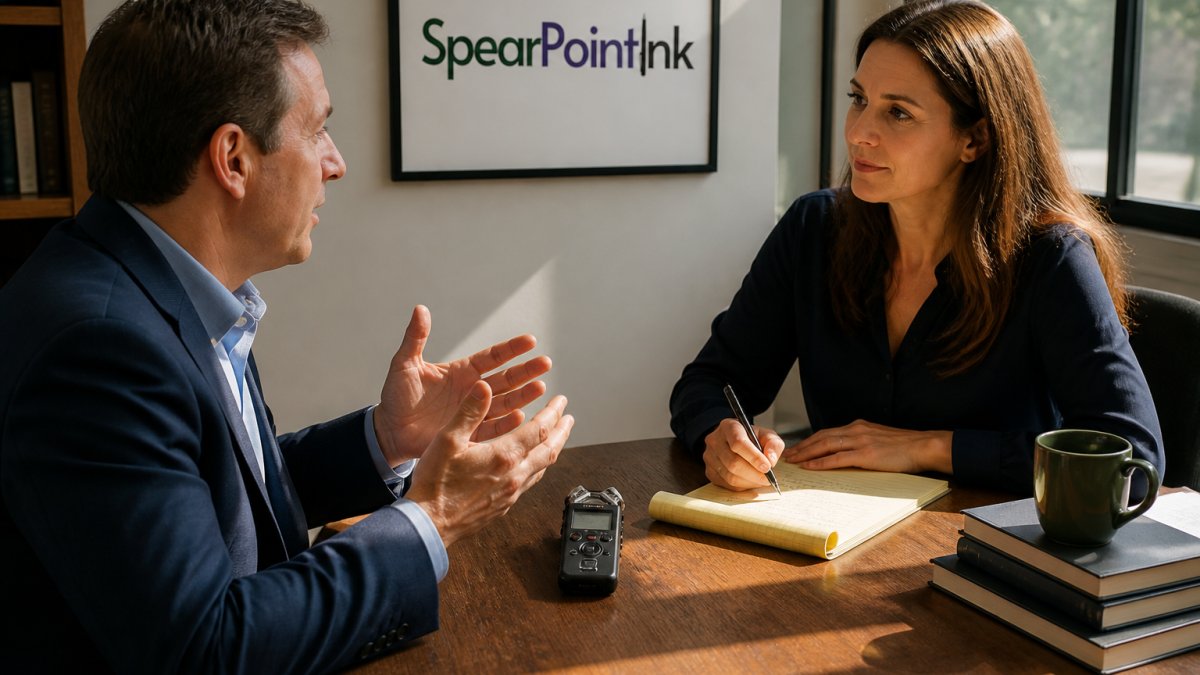
When it fails, it fails predictably. The writer substitutes their own vocabulary for yours, and the manuscript sounds like a competent stranger. Readers who know you spot it in a paragraph. The fix is not more editing passes; it is going back to the recordings and asking where the real answer got smoothed over.
If the draft sounds like a well-written version of anyone, it is not your book yet. Voice lives in specifics: your examples, your hesitations, your particular way of ending a point.
What Belongs in a Ghostwriter Contract: Rights, Milestones, and Kill Fees
A ghostwriter contract should settle three things: who owns the work, how progress is measured, and what happens if either side walks away. Copyright transfer should be explicit and tied to final payment. Milestones should be dated and tied to deliverables, not vague phases.
The kill fee deserves its own paragraph. If you cancel after the outline is approved, the writer has already done real work. If they withdraw, you need a path to the material produced so far. Spell out both directions. Authors who skip this clause often discover, mid-dispute, that they cannot use the interviews they paid for.
The Hiring Process, Start to Finish
The hiring process is shorter than most authors expect, but it is front-loaded.
- Discovery call. You describe the book, the audience, and the outcome you want.
- Scope and quote. The writer proposes length, timeline, interview cadence, and price.
- Sample chapter. You see how they handle your voice before committing.
- Contract and deposit. Rights, milestones, and kill fees get signed.
- Interview phase. Recorded sessions extract your frameworks and stories.
- Draft and revision cycles. Chapters arrive, you respond, they revise.
- Final delivery. Manuscript, files, and rights transfer.
The interview phase is where the book is won or lost. Everything after it is execution.
Conclusion: Your Book Is an Asset, Not a Project
A leadership book is not a one-time deliverable. It is an asset that keeps working: in pitches, on stages, inside client onboarding, long after the meetings end. The challenge is that the thinking behind it decays if it is never captured properly. SpearPoint Ink builds Authority Assets from that raw expertise, using recorded interviews to preserve how you actually reason, a structured process for business books, keynotes, and client education systems, and a focus on material that outlasts the engagement. Book a call and we will scope what your book could become.
Frequently Asked Questions
How do I hire a ghostwriter for a leadership book?
Start by defining what the book needs to do for your business, not just what it should say. Then interview two or three leadership book ghostwriter candidates, ask for a sample of their interview-based work, and request a paid trial chapter before committing to a full manuscript. A structured process matters more than a polished pitch: the writer should show you how they extract your frameworks, not just how they write prose.
How much does it cost to hire a book ghostwriter?
Ghostwriter rates for a book vary widely based on length, research load, interview hours, and how much structural work you need. Pricing depends on scope, timeline, and delivery, so ask each provider for a written quote tied to a defined deliverable rather than a ballpark figure.
How do I make sure a ghostwriter captures my voice?
Insist on recorded interviews rather than written questionnaires. Your spoken explanations carry the cadence, vocabulary, and analogies that make the book sound like you. Ask the ghostwriter to deliver a sample chapter early and mark every sentence that does not sound like something you would say out loud. A writer who welcomes that feedback is protecting your voice; one who resists it is writing their own book.
Who owns the rights to a ghostwritten leadership book?
Ownership is set by your ghostwriter contract, not by default assumptions. Most work-for-hire agreements assign full copyright to you as the author, with the ghostwriter waiving credit or keeping a confidentiality clause instead. Read the rights clause before you sign, confirm whether the ghostwriter retains any reuse rights to interview material, and make sure the contract states clearly who can register the copyright.
This article was written by SpearPoint Ink. For guidance on how a leadership book ghostwriter can capture your voice and turn your expertise into a lasting asset, contact our team.


